Monday, January 20, 2014

...Art Haus on Netflix...20JAN14...


Exploring the deeper side of Netflix tonight in a study of the alleyways between the thoroughfares.

Room 237: Kubrick's The Shining provokes reaction.  "237" is nine viewpoints that go wildly off the mark, depending on your level of involvement in the dubious concepts of conspiracy theory.  However, a fascinating time digging deeply into the movie: it's color aspects, it's symbology - and, at the end, despite my disagreement of some of the assessment, you learn to appreciate The Shining again.  Whatever Kubrick had in mind, we can definitely agree he made deep rooted choices in making it one of the best horror movies of all time.

Plagiarism in 2013: Ruth Graham proposes why did 2013 become the year of word theft?  The good news is that, in the writing community, it is, after millennia, still frowned upon.  It is property, it is the poet's.  Don't do it.

Caesar Must Die: A documentary that pits the context of Shakespeare within an Italian prison, the incarcerated troupe in their portrayal of Julius Caesar.  These men and the play they enact are a sight to see: they emote in a way that few actors otherwise can.


Gregory Crewdson: Brief Encounters: with the overabundance of cameras in the world today - there is a dullness to the art.  If everyone can take the same picture, since the phone or the camera takes much of the guesswork out, then what do we have left?  Crewdson, on the other hand, infuses much into each shot. I hate to use the word 'stylized', because it elevates beyond that, since the thematic tones that he strikes are decidedly not sleek.  They are a hyper-realization of a moment that is struck within him - the light and colors of some memory that you understand lives within him.

Mystery of a Masterpiece (NOVA): what is compelling in this piece is not the framework of the story that NOVA puts forth, it's the underpinning that Leonardo Da Vinci could possibly thrill us several centuries after we believed we've seen all of his works.  Could this portrait be his?  The signs outlined in the documentary point to a high degree of confidence it very well could.

Science as a cult of instrumentation: Philip Ball, of Aeon, argues the vacuous ideas of science feeding upon each other instead of expanding our conceptual basis of what to do next.

"Beauty" a Short Video by Rino Stefano Tagliafierro - a work that elevates the flaccid genre of online video repositories.

B E A U T Y - dir. Rino Stefano Tagliafierro from Rino Stefano Tagliafierro on Vimeo.

General Orders No 9: a visual dream of Georgia, USA.  A stream of consciousness that looks under, around, its impact as a state.

Mark Twain and the West: Lapham's Quarterly surmises Twain's The Celebrated Jumping Frog of Calaveras County as a humorous aside of post-Civil War, albeit with a larger lesson on a reflection of that age.

Indie Game: a lucid (as you'll find many articles written on it as well) look at the state of independent games today.  The frustration of coders who put their all and a year or two, into a title to see that they just didn't get enough from it.  A sad state of affairs for those that would like to see art in a genre that is dominated by war, space or undead titles.

Wordle: EdwardianJackal 2013

Jiro Dreams of Sushi: the dream is a luscious one, filled with knowingly cut pieces of salmon.  For those wanting of more art in how katana blades are derived, see how Jiro presses his crew to understand the right way to start a fire in the kitchen and to get the seaweed to taste 'just right'.

Chuck Woolery sings, possibly high:

Wednesday, January 15, 2014

...the edwardianjackal "7" fascinating handheld computation devices...14jan14...

Handheld computational devices, in chronological order:
BC 30000: Tally Bones ~ Ancient Man would use the bones of its prey (baboon (Africa) or wolf (Czech)) to carry with them and make tally marks, or, as some suggest, make calculations.  A departure of early man from what would be considered sentient 'others' is symbology of conceptional ideas.  In this form, early peoples would have a medium of record, portability, and malleability.  As we can speculate, this mathematical artifact is more than a crude tool - it had to have been used as a center of discussion, debate, forethought.  It was, in effect, an extension of thought: not toward an outcome or to change a state of another object.  It was conceptual, where ideas could grow.

BC 1800: Cuneiform Script Tablets ~ a well known example is the Plimpton 322 tablet, created from a contemporary of the biblical Abraham.  There are very few extant works in clay, as you can imagine their permeability does not lend itself as other materials for permanence...but for the Plimpton tablet, we see a Babylonian society keeping a table of Pythagorean triples.  'Why' is not the question here, since, as with logarithms, the purpose is to hold numbers not easily memorized otherwise.  For example, in the fourth column, they have listed numbers for the width of an object at 12709, it's depth at 18541 and its diagonal squared at 3437686681.  Tablets were malleable, reproducible.  The thriving mercantile of commerce centers lived off of them.  They were a formal introduction to math as receipt, as reference, as trust.

1200 AD: Suan-Pan, Abacus ~ outside of reference, how would one make calculations outside of proofs?  Meaning, how can the common merchant make calculations on the fly?  You construct a device that symbolizes values in readily desired amounts: single units, then in factors of five.  Tens, hundreds, thousands, etc. can be derived quickly.  It was indeed portable.  It was a technology.  It also allowed for shared experience, since both the merchant and the purchaser could see the calculation's value on its display.  The leap in technology was apparent - it allowed humans to make dozens of calculations a minute if needed.


1614 AD: Logarithms ~ made famous by John Napier in his A Description of the Marvelous Rule of Logarithms.  The theme here is making difficult calculations easier, especially those that take time to do by hand.  They also can help measure against a base-10 construct, like the Richter scale, where each progression of the scale, 1-10 increases by a factor of a 1000.  In computer science, binary logarithm (base 2) is used heavily.  With Napier's 'Bones', a portable cylindrical device helped with complex equations and be the basis of the next device.  Ship's navigation required the use of solving trigonometric conventions quickly.  Gunter's Scale is another similar device of this category.

1621 AD: Slide Rule ~ imagine a device, pre-electronic age, where one could figure multiplication, division, trig, squares and roots, cubes and cube roots, and logarithm on something that could fit in a pocket?  The slide rule is an unsung hero; derision-forming because of its reputation for 'nerds' in the mid-century.  It need not be so.  Its impact on all modern devices is indisputable.  The efficacy an engineer had from performing work instead of drawing out computation is its beauty.

1948 AD: Curta Calculator ~ the story of Herzstark's indoctrination into Buchenwald in World War II, where he finished his design of the handheld calculator is well know.  But, how does this fascinating contraption work?

1972 AD: HP-35 ~ my mother actually had one in the late seventies, since she need to perform transcendental functions for her work in circuit board creation.  For all of us in the seventies,  having something electronic, with a display was the future.  The only portable devices were transistor radios, that rarely had anything other than a mechanical display.  The HP-35 smelled amazing, it smelled electronic.  The display was a light-emitting red diode (a Cylon scrutinizing us?).  It felt like the future, but dang, did I not know how to use it for several months.  It wasn't intuitive, as it probably wasn't supposed to be.  Those that knew slide rule had a better go of it.  Reading the instruction slide, in the back of the unit, was something out of Star Trek, I tells ya!
Where the slide rule was mid-century, where is was analog - the HP-35 was all about the new century, the electronic frontier.  It was a singular calculating device that would eventually make way for the multi-functionary devices of the late nineties.

Tuesday, January 7, 2014

...a post-Christmas, an eclectic $100 haul...

...ah, Christmas!  A mixed bag for adults, surely.  The glow is not dimmed, however, at the sight of cash and gift cards - bring 'em over, I say.  What to do but go over to Barnes and Noble for an eclectic haul?  A C-note is the budget.  Score?  Had the salt-and-peppered haired clerk squint at me and gave me the 'reward for best taste of that day'.  Choice, right?!  [Would I have preferred the sight of a cute brunette with thick rimmed glasses and glossy burgundy lip balm saying the same.]

MUSIC (x7): B&N has a not-so-shabby selection of 4.99 and 7.99 CDs, which is cheaper, if you know what to look for, than their digital counterparts.
- Benjamin Grosvenor "Rhapsody in Blue" 14.99 - ok, so I broke my rule and I took a chance on the disc based on the cover.  Why not?  That laconic Briton in the wrinkled suit said, 'I don't care much if you buy me or no.'  That's the point of analog browsing.  Grosvenor is an incredible pianist. He has a lightness of touch and (surprising to the person who bought it) did put an exceptional twist to Saint-Saens, Ravel and Gershwin.  I recommend it highly.
- Various "Puccini and Pasta" 5.99 - Don't be fooled by the goofy cover and title.  This is actually an understated CD of great music to have a romantic dinner by.  The collection of Puccini's greatest hits, as it were, are performed by the A-list (Carreras, Domingo, Caballe, etc).  Plus the price can't be beat if you are looking for something to dive into opera.  Puccini's melodies get me hot and bothered: I am not ashamed.
- Jackson Browne "Running on Empty" 8.99 - Ok, I've never gotten around to a few greats in my life, due mostly in part to growing up less-than-middle class.  JB is one of those that I simply couldn't get.  In Running, their is a tremendous tenor of thoughtful tracks like the titular song, 'The Road', 'The Load-Out', 'Stay'.  This is definitely a cruising around at night disc.
- Sam Cooke "The Rhythm and the Blues" 6.99 - This is one of those discs I feel almost embarrassed it is at this price.  Sam Cooke is one of my top five voices, easily, and this disc has 20 tracks.  'Get Yourself Another Fool', 'Fool's Paradise', 'Please Don't Drive Me Away' - sure I have more than a few of these on 'Night Beat' (an amazing album), but just check the track listing and argue with me that this isn't a tremendous get.
- Van Morrison "Astral Weeks" 7.99 - Like Jackson Browne, simply wasn't able to buy Van Morrison when I was younger, but I was a fan.  I've picked up very few songs, but Astral Weeks is a watershed moment in his career ('68) and I didn't know much about it until reading the wiki on it tonight.  Apparently it was a deal at the time.  What I hear is nothing like what Van is known for, 'experiment' is a poor word for it, but 'auteur' is closer.  It's as if you hear the culmination of his music, his voice and his compositions exactly as he hears them in his brain - it's a fascinating listen.
- Steve Martin "A Wild and Crazy Guy" 4.99 - ok, ok, I got this because I love Martin's earlier stand-up, particularly the next CD, but, this one has its moments.  The first half is the more brilliant side of Martin, where the second is the side we may not care so much for (or use the word "detest").  Either way, this is a moment in time, 1978, and how the gritty comedy of SNL moved into commercialism.  But, again, the price is worth the admission.
- Steve Martin "Comedy is Not Pretty" 6.99 - now, ok, this album is what I grew up on and it departed heavily from the 'King Tut' Martin and into, to me, much more polished and less zany Martin.  I was lucky to buy this at Anaheim Plaza, with the dollars I had, on cassette.  There was a Sam Goodys with a box in the front. I wore that cassette out and know every bit by heart.  Comedy, yes, is not pretty...hopefully it never is.

BOOKS (x3): Someday I'll have space to house my book collection in proper shelving, but that's a day I suppose I don't want to see.  It means I have enough time.  Never!
- "The Love Poems of John Keats" 10.99 - have the companion book, "Sonnets of the Portuguese" from Browning, and love the formatting of the book.  It's the perfect heft, feel and paper weight for poetry - if that makes any sense.
- Rimbaud "A Season in Hell" 12.95 - A browsing find in the poetry section, which took me a while to figure out where it was in the Fullerton store (shaking my head, help me).  Rimbaud was the forerunner of Beat movement (Ginsberg called him the first 'punk'), with a self deprecating bible of sorts, all written before the age of 19.  A fairly openly gay writer in the mid-1880s, Rimbaud's life reads like a novel itself.  The poetry is translated alongside the original French text - superb!
- Various "Haiku" 15.95 - I tend to sway from the mini-coffee table format, but I need haiku books.  For some reason, the poetry books at the store fronts are in deplorable condition.  Why do folks disenfranchise poetry so?  Because most of you hate it!  Yay!  Anyway, Basho and other haiku-ists abound alongside Japanese prints.  Pretty.

MISC (x2): Other things.
- Deconstructed Journal - Clock Faces 12.95 - just a solid, organic-y journal. Gonna use it to slam that Seqoi story in the crotch.  I own you, weird characters!
- Mighty Bright Book Light 10.95 - need to read my Sherlock Holmes compilation before I go night night - it hurts my brain trying to think ahead of the master.  But the light does its job well.  Thank you, Mighty Bright.

If you stuck around this long - you are a champ!

Saturday, December 21, 2013

...Study of the Seqoi...The Minister's Preface...

...picking up further into the study of the Seqoi.  Here we pick up with Tekawa's work alongside linguist Dr. Jaxon Nikolai.

Abridged audio notes of Tekawa and Nikolai on Panel 10 Wall 2 through Panel 3 of Wall 4 of the Queen's Temple.

[GT:] The Vizier, Maliq, had started his Narratio Tabulum within the Queen's Temple several years before Seqoi's Fall.  It's primary purpose was simple: to adore the Queen in all aspects and worship her for ages to come.  The peoples of the valley were induced to comply to the wants of the Vizier and had to be the only employ of the Temple and the Cave constructs.  There would not have been much labor in the region, particularly at this time, and we don't have indications from my colleagues that slaves were kept.  At least not in apparent bondage, nor do we have indications that there was spoils of war during much of the Queen's reign (not yet in this narrative, at least).  [At this point, they were about 60% of the way through the Tabulum.]

[JN:] And, as we see variants in the construction of the language, I have a growing opinion that the Vizier is piecing the language as one who had any formal desire to standardize the Seqoi language.  My guess at this point is even the Queen may not have understood the designs that Maliq had started, outside of building a functional structure, perhaps by his use in court.

Key symbols remain fairly consistent, but transitional and conceptional symbols do shift, though Maliq does make repeated attempts to keep the story intact.  At this point in the Tabulum, I feel he has at least one person helping him (dubbed 'Btopon', Russian for 'second').  The language surrounding the Queen are refined from the original block at times, apparently where the Vizier is correcting what Btopon may have originally cut into the stone.  It does settle over time, so they are learning together.

We find this in many early cultures, where the psychology of those struggling with a language, 'feel' their way through it.  Language is organic, no more proof than this.

[GT:] As there was a lack of paper, we assume they used clay, which is plentiful enough in the cave lakes of the region.  The Tabulum would have connected a commonality in language for several years, and more had the Seqoi survived the attacks that ultimately destroyed them.

[JN:] Ironic that Maliq foreshadows this destruction in a similar city that we have yet to find:

"Not unlike the fallen temples of Amarifa, and their limbless statues that no longer reach
They scattered with the stones, as if they were the mountain's bones
Felled by the enemies' triumph

Their eyes turn inward, and the brightness of the stars are lost to them
The frozen winds of the night give them no comfort
The rocks become lesser rocks

And I am alike with out my Queen

I am the empty desert by lack of her embracing arms
The bare stones of the mountain's head
The extinguished fires of the brazier
In the still of the night the animal's rest
But no comfort for I from you"
- P13 W2 to P5 W3

[JN:] Working with an ancient musician team a year later, we pieced parts together in a temporal piece, attributed mostly to Janice Collins:

"The statues laid bare upon the ground, the promise and illusion dead
And so am I
My tears are cold as the nightly wind on the desert sands
No comfort now

I lack you and the stones provide little in your wake
Shattered me
When all is lost and all is gone, memory serves little
And I cry once more"
...

Tuesday, December 17, 2013

Professor Tekawa and the Lost Civilization of Seqoi

FORWARD
What I relate here is nothing of my own opinion, or is it embellished in any way.  As a historian in the purest sense, we must always look for fact.  Unadulterated fact - not swayed by the opinions of the person, or worst, by the fashions of the contemporary - which are filled with dangers.  Historic half-truths, which are what fashions unabashedly reveal, luckily do not stand the test of time.  As long as there are historians who prove the purpose of their calling and only duly purport a mirror of an age.

Professor of Sociology, Dr. Gale Tekawa, Ph.D. UW Madison, of California State University at Fullerton, outlined a series of lectures as part of her curriculum, "The Curious Pre-Romanticism of the Ancient Seqoi"*, which included several artifacts she acquired in her discoveries of the site in the very early 1980s in the region of south-east (present day) Algeria, about two hundred miles SEE of the city of Tamanrasset.  Dr. Tekawa worked along side Drs. Blake and Willowby, Professors of Archaeology, at the site in its infancy.

The site, first thought to be a derivative culture of the Berber, was discovered by Tamanrasset militia in 1976.  Funding proved a chore for UW at the time, but it was finally meted out by interest by Pan African groups seeking more solidity to studies of Africa as the 'birthplace' of civilization.  [I use quotes very sparingly.  In this case, I seek to use the language of the grant, but flatly point out the disingenuous proposition of the term.]

The site found the three doctors working four weeks out of the year, for several years, as scouting expeditions.  Opportunity was with them each trip, successive discoveries abounded.  [As this is the story of Tekawa's journey, and my interest in her hypothesis, I will merely outline those that are the focus of this paper.]  As monies consolidated for the team, the University felt enough was collected that a full expedition and study could be made for at least the first year.  The doctor's were so excited they left for Africa before formal arrangements were made.

The first year was slow work.  The indigenous peoples of the area proved unreliable so men from Cairo and Baghdad were brought in at three times the amount - but five times the amount of work was had.  The first year was primarily for the archaeologists - they discovered an ancient kingdom that flourished only for a brief period of time thousands of miles west from Mesopotamia.  There were underground lakes and rain-collecting cisterns.  There was some cultivation of barley.  There is evidence of crude metallurgy, but nothing approaching the bronze masterworks that would frame much of the time.

...

It was the discovery of a temple, built intentionally underground, as part of a center of worship where the site took a turn of its own.  Tekawa found there a series of works written in the stone of the chamber that appeared to be an extant story, untouched by time and most elements.  It was crude and it was fragile.  If it was what it could be, it would predate the work of Beowulf by some 1200 years.

As Tekawa turned the next two decades to this work, she sought to turn them into a meaningful whole.  From it she found, not a fictional tale or a religious sect's search for meaning: it was a story of the Queen of the Seqoi, and the Minister that loved her until the temples were toppled by a wandering army sometime in 2435 BC.

It was a tale that possibly alluded to by Dionysius Periegetes in his De situ habitabilis orbis:

in hac regione est oppidum ab antiquis invenimus mortuum

sed melius est, et ex lapide sepulchra, quae superne rotundata sunt Caeli
multis nota picturae et fecit
sed qui apud nos est, non possint?


it was in this region from the ancients that we found a dead city
they preferred the rounded tones of stone and tombs
many a picture and symbol made
but who among us could decipher it?

That began Tekawa's proposition that this kingdom, so infant to other civilizations, masterful of little but the crudest instruments, found purpose in extolling the stories of a man we know little about.  We know that he was in love with the Queen and outlived her.  The man (dubbed Seqoi Alpha, or the Vizier, or Maliq) who saw his own civilization crumble, and a fragment of time that no one could recall but through his story.

...
Upon once of her travels to and from the States, Tekawa had stopped in Spain, to the University of Barcelona, studying the manuscripts and of the symbol the Seqoi Alpha had made.  It was a symbol of a woman, in the crude valuation of a dress, characteristic bosoms, and a disk behind her head.  The waiter of the Spanish tapas bar remarked, Reina?  Queen?  So began the tale of the man who loved Reina, the Queen of the Seqoi, the Single Civilization, the Invenimus Mortuum of Dionysius.
..
* The Seqoi Culture: A Study of Pre-Bronze Time in Their Words, Dr. Gale Tekawa, Azalee Press, 1992

Saturday, December 7, 2013

Communication Failures and Pearl Harbor (07DEC13)

In a 1969 interview with Commander Etta-Belle Kitchen, Captain Joseph J. Rochefort, USN, said accurately, "I have often said that an intelligence officer has one task....to tell his commander today what the enemies are doing tomorrow."

To what would attribute to the failure of Pearl Harbor?  Offering little excuses, Rochefort explains the ones that are typically burdened upon Signal Units: lack of equipment, lack of effectiveness, lack of coordination and a lack of successful cryptoanalysis.  These led to failure.  The intelligence and communication effort on the island of Oahu suffered for it.

There was a lack of wired communication lines between forward signal sites.  Messages were biked or jeeped to respective command buildings.  This alone is a failure, especially in light of the attack: the Japanese flanked the island in two successive waves, each massive wave less than an hour apart.  The attack itself is well known: the Japanese were to stun the American Navy in the Pacific and hopefully delay retaliation by the US for six months.  Radio or telegram is key, in the least, for alerting defensive units.

I would offer that the shape and topology of Oahu should have accounted for this as well.  Signal units with proper radio communication should have encircled the island with at least twenty minutes to rally and mount a defense at Ford Island.  Having to physically move messages from a site to command, you lose the ability to rally.  The wave will already be on top of you before you can respond.  Considering that the average Japanese bomber airspeed was around 250mph, you would need sufficient time to signal ahead.

Considering the topology of the island, I would offer what wasn't being done, and fairly similar to what was being done on the Continental Pacific Coast.  Close alignment with defensive units, a hub of radio networks, centralized signal command, and close alignment of scout balloons or planes.

Unfortunately, the centralized command at Wahiawa, near the middle of Oahu, was not to be completed until 1942.  Most of the radio equipment that could have been deployed in the Pacific was being moved into Europe.  Worst of all, the Japanese rightly changed their cryptography on 12/1/41.  This proved highly to their advantage.  The US would be months away from re-cracking their codes - much less be of any use before the 12/7 attack.

Mobility of stations, not brick and mortar, will always prove invaluable when creating a scheme of operability in a new theater.  Camouflage of equipment and periodic cover changes across the face of the island, in coordinated cycles, would have seen a highly integrated and effective network.  Extension of the network would have been in the form of scout towers, balloons or planes.

As to equipment, there should have been no excuse.  If military equipment is unavailable, the beauty of radio communication is that you don't have to necessarily rely on perfect hardware.  Civilian equipment, in the form of existing radio stations, HAM and other readily available types could have, in the least, prevented the situation that the USN saw themselves in prior to the attack.

A logistical issue that Rochefert encountered was relying on crypto-analysis from DC, with very little resources in the field.  Of course, there is a reason to keep your best analysis away from a theater of operations, but stations in San Francisco and Los Angeles would have been ideal.  If we take Rochefert's mantra to heart, as soon as the code of JN-39 was changed, all efforts should have been made to get some traction on the new codes.  From a signal standpoint, a change in codes should have also put a higher alert status in all forward stations.

By the time the Japanese attacked with their first wave (49 bombers, 40 torpedo bombers, 51 dive-bombers and 36 fighters) it was too late.  Signal traffic coming at the start of attack does little good when bombs are falling.  [The second wave came with 54 bombers, 78 dive-bombers and 36 fighters.]

Strategy would have centralized at Ford Island until Wahiawa was up and running.  Five mobile forward sites in Oahu would have called into repeater stations mid-island, pulling in traffic from scouting units.  Routing of messages should have gone to both Wahiawa and Ford Island.  Forward mobile commands would proven somewhat worthless, so emphasis on scouting units, with a comfortable range of 20 miles out to sea, forms a virtual line of intelligence away from the island (northern islands of the Hawaiian chain prove to hard to defend adequately).  This would account for about three scouts to each forward site, or fifteen overall radio units, two repeater stations, and simultaneous command at Wahiawa and Ford Island.

Crypto-analysis should be done on a four hour cycle, with intelligence gatherers collecting data on such a shift, parsing through it and sending off in similar cycles to the mainland for analysis.  Gathering would be done repeater stations and at command (adequately done, this would have you looking at twelve trained analysts and a field division office of no more than two captains and a commander).

In such a configuration not only would the attack have been weakened by defensive units on Ford, it could have been repelled.  We would assume to that the counter attack by our own air units could have been guided to the correct location of the Japanese, instead of heading to the south as was done.

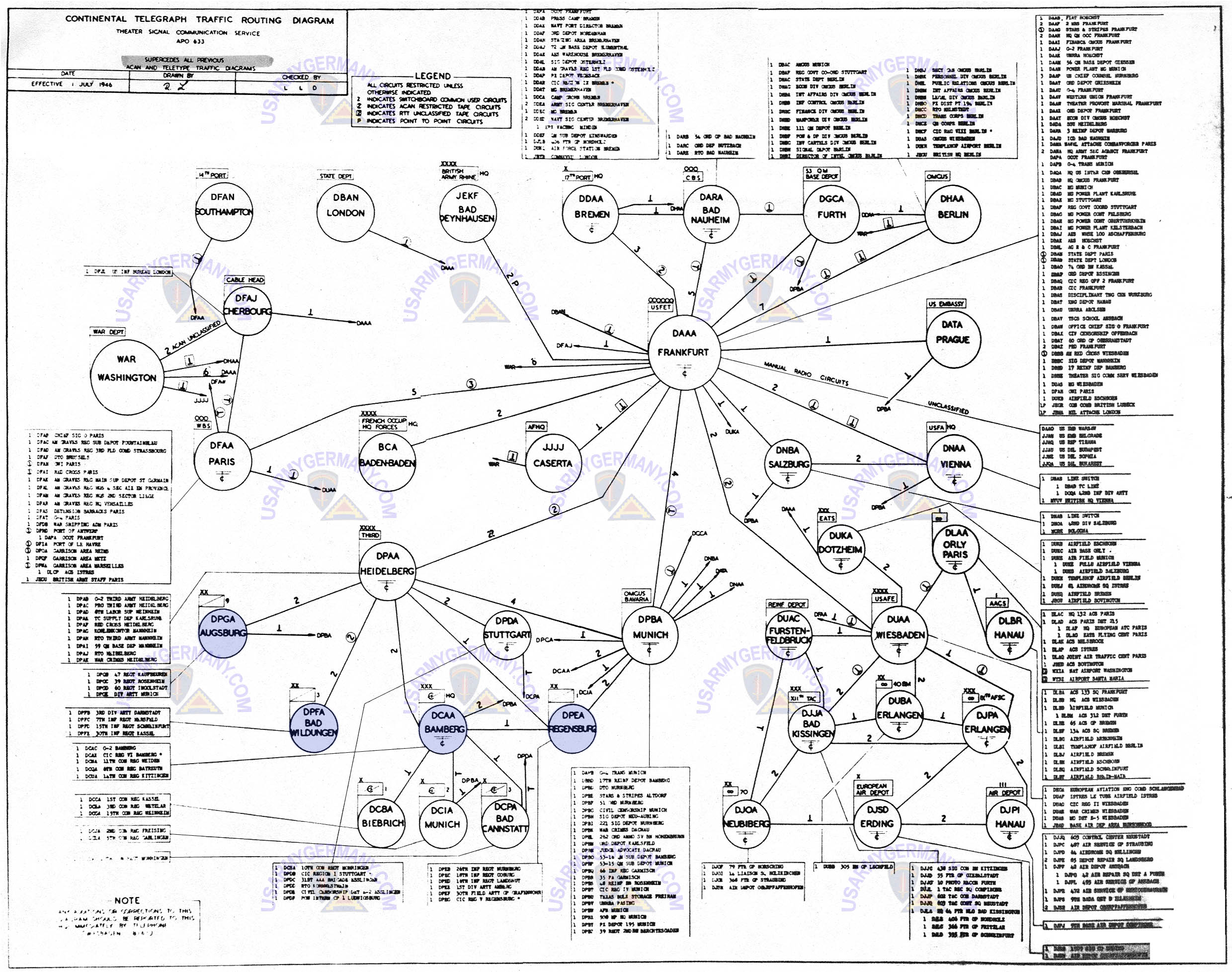
A view of post-war operations in USEUR (US Europe Command) shows the start of a highly integrated network of telegram communications as an example of how such a network should look.


Tuesday, December 3, 2013

do = c, re= d, mi = e, fa= f, sol = g, la = a, ti = b

The inventor of solmization was Guido of Arezzo (995-1050), who used the six syllables of ut re mi fa sol la located on three degrees of the diatonic (C major) scale (e.g. c d e f g a).  Guido derived these from an 8th century hymn to St. John the Baptist, the melody of which has six lines starting successively on c, d, e, f, g, and a: Ut queant laxis, Re-sonare fibris, Mi-ra gestorum, fa-muli tuorum, so-lve polluti, la-bitt reatum ("So that your servents may sing at the top of their voices the wonders of Your acts, and absolve the fault from their stained lips").  In essence, Guido  created a system of designating the degrees of the scale by syllables rather than by letters.

Guido theory of the hexachord, where there a group of six consecutive tones with a half tone in the middle is based on the diatonic scale, the first, outlined before, of 'c', or the hexachordum naturale.

After his contributions, the Guidonian hand was developed where the topology of the hand could be used as an aid of memorizing the scale, from tones of G (at the thumb) to e" (at the tip of the middle finger).  c d e f g a b would be derived by the bottom of the pointer, across the ridges at the top of the palm up through the pinkie.

So, when Dame Julie Andrews says she's 'making it easier', what she means to say is that is was manufactured over 800 years prior by a monk who grew tired of the monotony of Gregorian chant.