Showing posts with label shakespeare. Show all posts

Thursday, July 21, 2016

then:Poppy Drayton and Shannara

“Fantasy writing must be grounded in both truth and life experience if it is to work. It can be as inventive and creative as the writer can make it, a whirlwind of images and plot twists, but it cannot be built on a foundation of air. The world must be identifiable with our own, must offer us a frame of reference we can recognize.

“Fantasy stories work because the writer has interwoven bits and pieces of reality with imagination to form a personal vision.”

Drayton as Amberle - with a bit of Photoshop play to the original.
Shannara, written by Brooks, is a set of ten high fantasy novels that have been adapted into an MTV series, starring Poppy Drayton.  The show straddles the line of keeping the spirit of a post-apocalyptic earth -  now embued with magic and a species evolution of humans, elves, trolls, gnomes and dwarves - while spinning a bit of pop through-out (read: sexy).  There is an overtly obvious connection to tap into the Game of Thrones anthologies on television lately, so Shannara is an epic that can span several series.  Specifically, the MTV series is based on The Elfstones of Shannara, which is actually book two in the series, but serves as a reasonable point to follow young characters on a quest to save the world from demons.

Armed with Brooks' quote above, and watching the series on Netflix, you get a sense of the didactic world of Brooks.  There is very sharp lines between good and evil, innocence and cynicism.  Wil Ohmsford is the last of his kind and holds precious magic that can usurp evil, and he must do so in the service of the young queen Amberle, who, in turn, can maintain the 'tree of life'.

And Amberle (Drayton), who's break-out role was on the Downton Abbey, playing Madelein Allsopp, brings an over-vulnerability to Amberle, who has the world upon her shoulders and enemies seemingly on all sides.

Drayton as Juliet.
Drayton's first major part was in a stage production of Romeo and Juliet, playing the titular role.  This (as she intimates in this interview) was the role she most desired to play.  Having a classical background as well as a great camera presence, makes Shannara a series to binge, especially if you are a fan of high fantasy and a bit of the post-apocalyptic.

As Juliet was her role, I thought of the difficult aspects to play in light of Juliet's last speech:

"How if, when I am laid into the tomb,
I wake before the time that Romeo
Come to redeem me? there's a fearful point!
Shall I not, then, be stifled in the vault, [2585]
To whose foul mouth no healthsome air breathes in,
And there die strangled ere my Romeo comes?
Or, if I live, is it not very like,
The horrible conceit of death and night,
Together with the terror of the place,— [2590]
As in a vault, an ancient receptacle, "

And someone on youtube (of course) has put together this scene study:


And then I return to Shakespeare.
...

Sunday, February 1, 2015

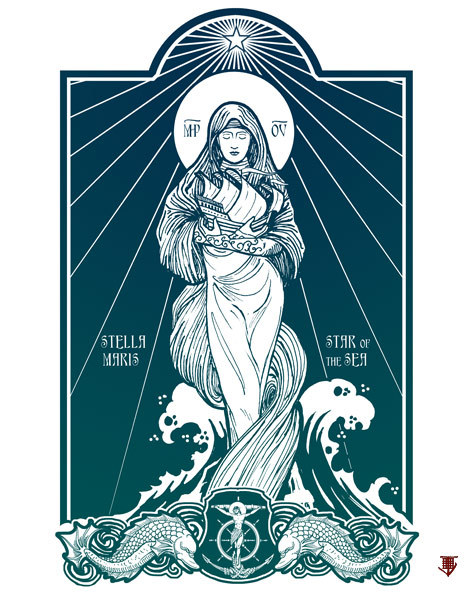
...Stella Maris...The Star of the Sea...


In the rendition of Verdi's operatic Otello, Desdemona, the wife of Othello, sings a prayer to Mary, a departure from Shakespeare's play.  In Act 5, Scene II, Desdemona pleads for a stay from the death of the hands of her husband, and pleads further that she may say a prayer.  In Otello, it is realized in a resounding Ave Maria that is hauntingly punctuated on the 'amens' and the 'prega per noi' (pray for us).  Desdemona has her prayer by Verdi's composition before she is smothered by furied husband.


PLAY:
OTHELLO: "Ah balmy breath, that doest almost persuade Justice to break her sword!  One more, one more.  Be thus when thou art dead, and I will kill thee.  And love thee after.  One more, and this the last: So sweet was ne'er so fatal.  I must weep, But they are cruel tears: this sorrow's heavenly: It strikes where it doth love.  She wakes." V, II

DESDEMONA: "...by this light of heaven, I know not how I lost him.  Here I kneel: If e'er my will did trespass 'gainst his love, Either in discourse of thought or actual deed....Comfort forswear me!...But never taint my love."  IV, II

As there are almost countless songs of the Ave, an early rendition of it has a foundation dating back to Saint Venantius Fortunatus, the Maris Stella:

Ave, Maris Stella, 
Dei Mater alma, 
Atque semper virgo, 
Felix coeli porta.

Sumens illud Ave 
Gabrielis ore, 
Funda nos in pace, 
Mutans Evae nomen.

Solve vincia reis 
Profer lumen caecis, 
Mala nostra pelle, 
Bona cuncta posce.

Monstra te esse Matrem, 
Sumat per te preces 
Qui pro nobis natus, 
Tulit esse tuus.

Virgo singularis, 
Inter omnes mitis, 
Nos culpis solutos 
Mites fac et castos.

Vitam praesta puram,
Iter para tutum; 
Ut videntes Jesum 
Semper collaetemur.

Sit laus Deo Patri, 
Summo Christo decus, 
Spiritui Sancto, 
Tribus honor unus.  Amen.