Showing posts with label communication. Show all posts

Saturday, December 7, 2013

Communication Failures and Pearl Harbor (07DEC13)

In a 1969 interview with Commander Etta-Belle Kitchen, Captain Joseph J. Rochefort, USN, said accurately, "I have often said that an intelligence officer has one task....to tell his commander today what the enemies are doing tomorrow."

To what would attribute to the failure of Pearl Harbor?  Offering little excuses, Rochefort explains the ones that are typically burdened upon Signal Units: lack of equipment, lack of effectiveness, lack of coordination and a lack of successful cryptoanalysis.  These led to failure.  The intelligence and communication effort on the island of Oahu suffered for it.

There was a lack of wired communication lines between forward signal sites.  Messages were biked or jeeped to respective command buildings.  This alone is a failure, especially in light of the attack: the Japanese flanked the island in two successive waves, each massive wave less than an hour apart.  The attack itself is well known: the Japanese were to stun the American Navy in the Pacific and hopefully delay retaliation by the US for six months.  Radio or telegram is key, in the least, for alerting defensive units.

I would offer that the shape and topology of Oahu should have accounted for this as well.  Signal units with proper radio communication should have encircled the island with at least twenty minutes to rally and mount a defense at Ford Island.  Having to physically move messages from a site to command, you lose the ability to rally.  The wave will already be on top of you before you can respond.  Considering that the average Japanese bomber airspeed was around 250mph, you would need sufficient time to signal ahead.

Considering the topology of the island, I would offer what wasn't being done, and fairly similar to what was being done on the Continental Pacific Coast.  Close alignment with defensive units, a hub of radio networks, centralized signal command, and close alignment of scout balloons or planes.

Unfortunately, the centralized command at Wahiawa, near the middle of Oahu, was not to be completed until 1942.  Most of the radio equipment that could have been deployed in the Pacific was being moved into Europe.  Worst of all, the Japanese rightly changed their cryptography on 12/1/41.  This proved highly to their advantage.  The US would be months away from re-cracking their codes - much less be of any use before the 12/7 attack.

Mobility of stations, not brick and mortar, will always prove invaluable when creating a scheme of operability in a new theater.  Camouflage of equipment and periodic cover changes across the face of the island, in coordinated cycles, would have seen a highly integrated and effective network.  Extension of the network would have been in the form of scout towers, balloons or planes.

As to equipment, there should have been no excuse.  If military equipment is unavailable, the beauty of radio communication is that you don't have to necessarily rely on perfect hardware.  Civilian equipment, in the form of existing radio stations, HAM and other readily available types could have, in the least, prevented the situation that the USN saw themselves in prior to the attack.

A logistical issue that Rochefert encountered was relying on crypto-analysis from DC, with very little resources in the field.  Of course, there is a reason to keep your best analysis away from a theater of operations, but stations in San Francisco and Los Angeles would have been ideal.  If we take Rochefert's mantra to heart, as soon as the code of JN-39 was changed, all efforts should have been made to get some traction on the new codes.  From a signal standpoint, a change in codes should have also put a higher alert status in all forward stations.

By the time the Japanese attacked with their first wave (49 bombers, 40 torpedo bombers, 51 dive-bombers and 36 fighters) it was too late.  Signal traffic coming at the start of attack does little good when bombs are falling.  [The second wave came with 54 bombers, 78 dive-bombers and 36 fighters.]

Strategy would have centralized at Ford Island until Wahiawa was up and running.  Five mobile forward sites in Oahu would have called into repeater stations mid-island, pulling in traffic from scouting units.  Routing of messages should have gone to both Wahiawa and Ford Island.  Forward mobile commands would proven somewhat worthless, so emphasis on scouting units, with a comfortable range of 20 miles out to sea, forms a virtual line of intelligence away from the island (northern islands of the Hawaiian chain prove to hard to defend adequately).  This would account for about three scouts to each forward site, or fifteen overall radio units, two repeater stations, and simultaneous command at Wahiawa and Ford Island.

Crypto-analysis should be done on a four hour cycle, with intelligence gatherers collecting data on such a shift, parsing through it and sending off in similar cycles to the mainland for analysis.  Gathering would be done repeater stations and at command (adequately done, this would have you looking at twelve trained analysts and a field division office of no more than two captains and a commander).

In such a configuration not only would the attack have been weakened by defensive units on Ford, it could have been repelled.  We would assume to that the counter attack by our own air units could have been guided to the correct location of the Japanese, instead of heading to the south as was done.

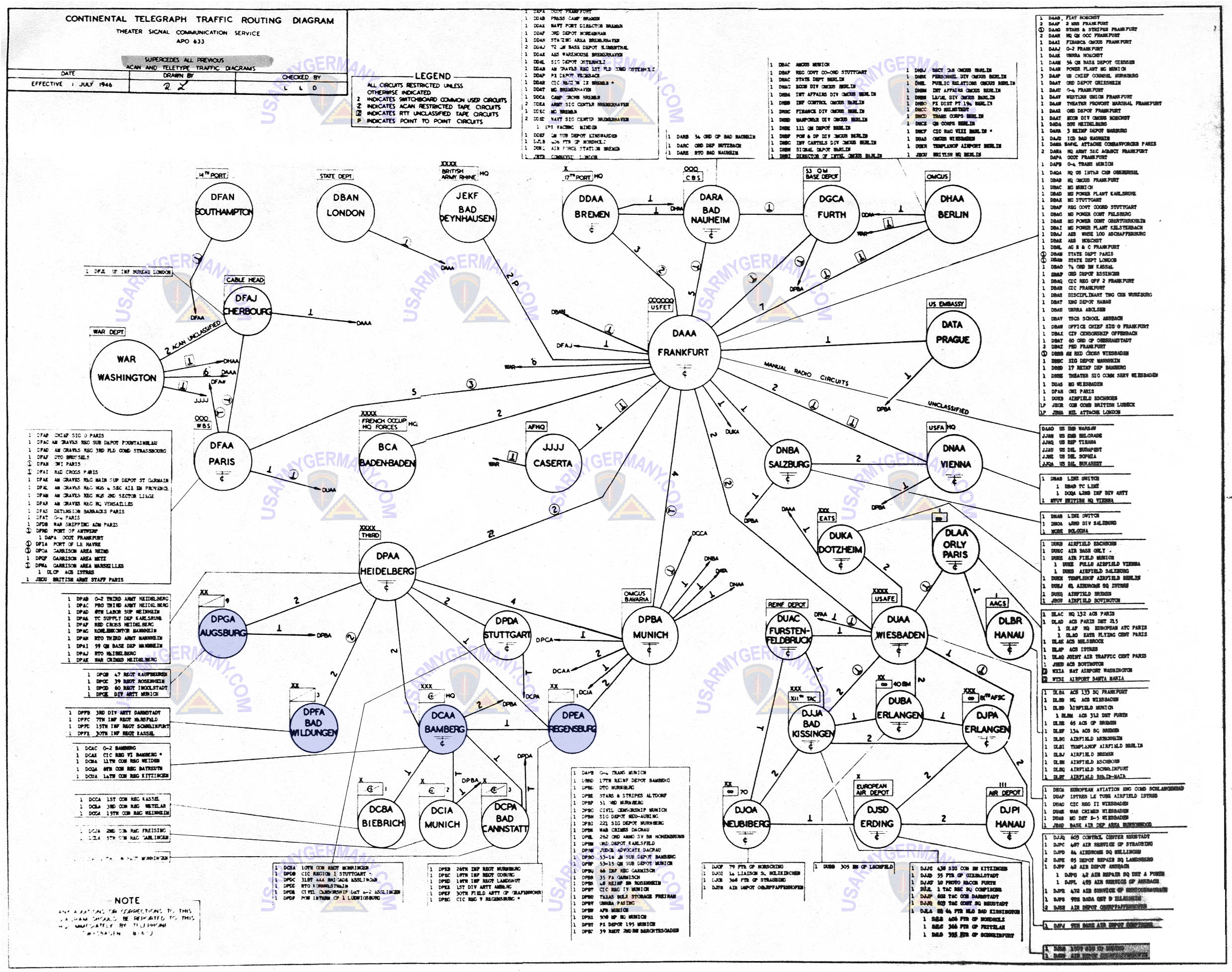
A view of post-war operations in USEUR (US Europe Command) shows the start of a highly integrated network of telegram communications as an example of how such a network should look.

Sunday, June 30, 2013

...electrical telegraphy, the first SMS system...

Silly short-sighted humans, what with their innate inability to not remember things, but desire to lunge head first into forgetting many things, in fact, as many things as possible.  Add to this the recent, and it has been relatively recent, prevalence of the smartphone, of the computer in your pocket, of "always on", of social space - it takes trial to be apart from your electronica.  It will be a wonder if the brain will re-adjust, for not too long ago, it was the minutiae of technology that we had to retain and use.

Well kids, there used to be a system that is well over 180 years old and was definitively the precursor to all that is today - that of electrical telegraphy.

It was, in the late 1840s, an electrical communications network that spanned tens of thousands of miles across the United States and Europe.  It brought communication instantly over major distances, where only physical carrier could have brought it before.  Because the communication was cost-intensive, folks had to come up with ingenious grammatical and spelling devices to get the benefit of saving a few dollars.  It was, in no short order, the first electrical proof of SMS communication.  (Where even some commentators assert that it was the first internet.)

With the closure of the last telegraph system in India (http://www.thehindu.com/news/cities/bangalore/telegram-dead-start-mourning/article4813592.ece), it is the end of a an almost 200-year old technology; and it was smartphone SMS that eventually killed it.  But, telegraphy built the foundation for all of modern cell, line, networked, switching systems.  Now, the seemingly simple set-up of electrical wire, electromagnets and some mechanical instrumentation will reside in museums, where the era of scientific nostalgia has still yet to happen (but abounds for cultural nostalgia).

We could have lugged this around, right?

But, if not for the restrictions of technology, we wouldn't do what humans do best: improvise with what we are given.  Telegraphy set the foundation for L337 or SMS phrases, as witnessed by this Western Union "92 Code" list, designed to provide a two-digit numeral to the most common telegraphy phrases: https://en.wikipedia.org/wiki/92_Code.  In particular, do these sound familiar?

- "88" - love and kisses
- "55" - important
- "13" - I understand

Or even "Wood's Telegraphic Codes" (1864):

- "1" - wait a minute
- "7" - don't know
- "N." - no, not
- "Q." - question

In the interest of speed and cost, telegraph operators found ways to be efficient: imagine that Morse Code was not originally designed to be anything other than writing shorthand, or receiving a visual display of the code.  Operators became so adept at interpreting the stream, they could listen by ear and understand the message.  [It has always frustrated me that I have never been able to do this - even after taking some serious time as a child toward the endeavor.  I would, however, easily adopt the phonetic alphabet in the Army.]


Consider some of the ingenious text msg short hand you could think of today, many coming from the days of ye olde pager:

- "10Q" - thank you
- "182" - I hate you
- "143" - I love you
- "^5" - high five
- "^URS" - up yours

Now that's just 2QT.