Showing posts with label reading. Show all posts

Monday, April 4, 2016

read: Ovid's "Metamorphoses" (Signet Classics, Horace Gregory translation)...

I picked up The Metamorphoses at a small book shop adjacent to the Hong Kong Citygate Outlet this past Monday.  Reading through it this afternoon, Ovid (via Horace Gregory) has a crisp cadence with his prose and brings the lives of Gods and Man to life.  Ovid also made particular care in telling the story of the Earth from beginning to end.  He was keen on the constant change of God and Man - their transformations from one form to another, may it be reward, punishment or dumb luck.

What strikes me, having read so many mythology books over time, is that the Gods of the Ancients were not fixed characters, but change according to each individual, and Ovid no different.

With the creation of Man, how poetic it sounds here, and how parallel to the Judeo-Christian ethic:

"As God divided regions of this world
Into their separate parts, then all the stars
Long lost in ancient dark began to light
Pale fires throughout the sky.  And as each part
Of universal being came to life,
Each filled with images of its own kind....

Yet world was not complete:
It lacked a creature that had hints of heaven
And hopes to rule the earth.  So man was made....

Then careless things took shape, change followed change
And with it unknown species of mankind." - Book I, page 5

Then it was not much later, in Book III (72), is the story of Narcissus, that it reminded me of the Beiber.

"....Enchanted by the charms which were his own.
Himself the worshipped and the worshipper,
He sought himself and was pursued, wooed, fired
By his own heat of love, Again, again...."

Sunday, March 13, 2016

Literary Charities 2016

I like to encourage everyone I know to give to charity.  It's this time of year that I like to give to literary charities, as literature is the vehicle by which we build upon our world.  Imagination pushes us forward, it changes our world.  Sharing ideas through books has been the powerful agency of progress.

Reading is Fundamental (http://www.rif.org/): the premise is simple, provide over 1,800,000 books a year to children that need them.  Through ownership and encouragement, provide the literacy skills to succeed in school and contribute to society.

First Book (https://www.firstbook.org/): has distributed over 135 million books across the US and Canada, serving low income families.  97% of proceeds go to this effort.

GlobalGiving (https://www.globalgiving.org/projects/give-books-to-children-in-the-philippines/): with 11 million functionally illiterate Filipinos, it is imperative that fellow Filipinos find ways to bring the literacy level up across the entirety of the nation.  Books are a path to ownership of knowledge, especially where internet is not as pervasive as it is in fully developed countries.

Children's Literacy Initiative (http://www.cli.org/shop-2/): outside of providing books, CLI provides workshops, coaching and institutes to 'teach the teachers' in ways to improve literacy skills with their students.

When a child receives a new book, he receives a treasury and a wealth that will serve them for all time.  Give today.


Tuesday, September 8, 2015

...a dream of maps, a dream of seas...

"He beheld an image of the Earth in his hands, held aloft.  He no longer saw it as it was commonly perceived: it was no longer the amalgam of its constituents.  The blindness erupted, he opened ancient eyes upon a faceted jewel.  He shifted the sphere in the sun's singular beam.  At once there shone the red core, the next the warming thrum of topaz, the next the clearest blue.  The world shifted, but he controlled its pitch, he controlled its effect." ~ The Lipherious Gazette, 08SEP15

As a child, what factors would draw you into a book?  It's cover most likely.  Next would be the author.  Perhaps a provocative title.  It's shape, paper weight, heft, smell, print, pictures, inlay, fore edge, fly leaf, end sheets, pastedown...things known and not yet known.  All of them combined were constituents to an experience.  You will hear this from me often: a book is technology.  From the standpoint of knowledge the democratization of the printed book has enjoyed a much greater lifespan of revolution, progress, education than the internet.  The internet would not exist if not for the book.  The erudition of the human citizen would be far less certainly.

What drew me well after a story was read, as a child, was the fictional map in the end sheets.  The maps of well known stories can instantly recall the hero's journey.  It can, in an instance, provide the eye all of the salient points of a book.  It allowed a child to dream.  To run a finger over rivers, across roads, feeling the courseness of the paper and the 'realness' of a story.

End sheet maps run the gamut of monotone or color.  If authenticity of age is required, the monotone sepia of the past lends credence.  Color is immediate and modern.  Each tell a story in different ways.  Here are a few of the ones that have led me on an endless journey to seek more...

The Princess Bride
Thinking more over it on the long weekend, it reminded me of Daniel J. Boorstin's The Discoverers.  Boorstin's strength in narrative is to take the recognizable and lucidly move outward then back inward, reaching out for the largesse then pulling it back to reflective ideas.  Discoverers looks at time (as clock), the earth (through its maps), nature (cataloging), society (community of knowledge).  Considering the (lack of) conventions of our age, Boorstin does not fit any singular continuity, but, I feel, allows for judgement and exploration of ideas.

"The great obstacle to discovering the shape of the earth, the continents, and the ocean was not ignorance but the illusion of knowledge." - 86

Narnia
"For [Gutenberg] was a prophet of newer worlds where machines would do the work of scribes, where the printing press would displace the scriptorium, and knowledge would be diffused to countless unseen communities." - 510

IT is within these maps that democratized imagination.  As Stanislav Grof said, "Ancient eschatological texts are actually maps of the inner territories of the psyche that seem to transcend race and culture and originate in the collective unconscious."

The Discoverers is available everywhere.

The Hobbit

Treasure Island

"Many a trip continues long after movement in time and space have ceased." - John Steinbeck

Sunday, October 5, 2014

...favored children's books on Halloween...05oct14...

The term 'vintage' for books falls woefully short, since good stories never go out of vogue.  Most of the time, they live up to their promise and are carried forward along with us.

As Halloween nears, there are few things as a child that we carry forward with the same emotional response than with horror.  Surely, we delight in it, we find exhilaration.  They give us a thrill like nothing else.  A good horror children's book will have a lasting impression upon our eager minds.  How many times did we hide a book, to hide from the sheer fear of its stories? Or, did you sneak them under the sheets, along with the all too critical flashlight, reading them in the unguarded shadow of night?

These are the stories I was lucky to fall into as a child, and have warped my senses since.

"In a Dark Dark Room" by Alvin Schwartz
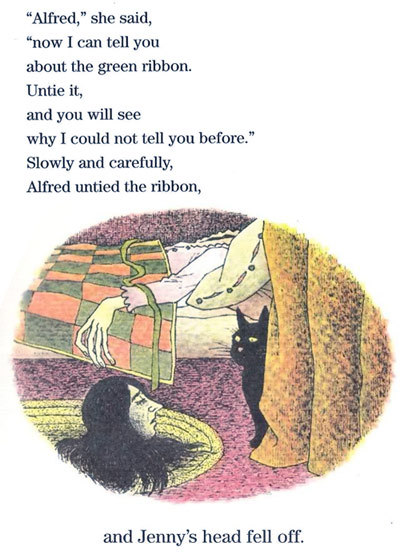
"In a Dark Dark Room" is so evilly bent.  The horror I felt as a child (at what I thought was to be a benign book) today gives way to a twisted pleasure.  The stories are deceptively short.  There is an efficiency of words.  Yet, tied with the illustrations, where they outline the real terror, are tremendously effective.

"and Jenny's head..." Jenny's head! It fell off her body, only because Alfred was unwilling to let her be.  Oh, Alfred, could you just enjoy her loving attention otherwise?


With the Berenstain Bears' "Trick or Treat", "In the Dark" or "Berenstain Bear's and the Haunted House"there are some genuine scary moments, especially considering the amount of danger the kids were in.

Imagine escaping from one's room in the middle of the night and running through the country side and into the dark of the forest.  That's just cray.

Alfred Hitchcock's "Spellbinders of Suspense"

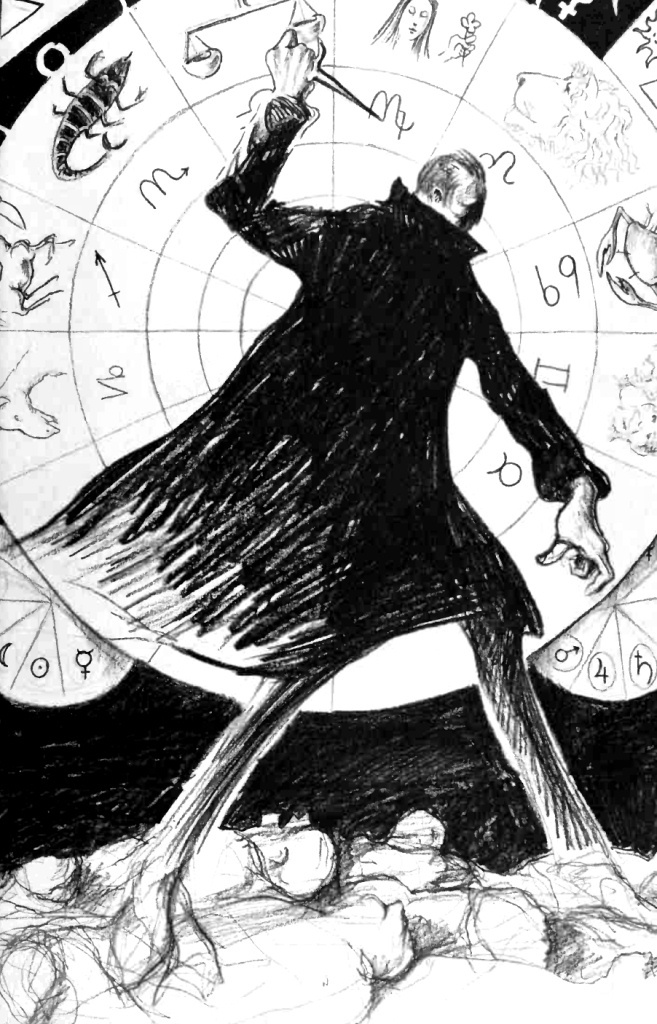
The Alfred Hitchcock series, which I've blogged a few times now, will always delight.  In "Spellbinders of Suspense", there are stories by heavyweights of suspense.  The illustrations were moody, though not heavily detailed.  Stories included:
"The Chinese Puzzle Box" by Agatha Christie
"The Most Dangerous Game" by Richard Connell
"The Birds" by Daphne du Maurier "Man From The South" by Roald Dahl "Yours Truly, Jack The Ripper" by Robert Bloch "The Man Who Knew How" by Dorothy L. Sayers


Then there's Hitchcock's "Haunted Houseful", with stories like:
"The Red-Headed League" by Sir Arthur Conan Doyle
"The Treasure in the Cave" by Mark Twain
"The Forgotton Island" by Elizabeth Coatsworth
"The Water Ghost of Harrowby Hall"


There's the raw artisan nature of "Georgie".  It's just terribly cute.

One of my go-to books,
Scholastic's "FunFact Book of Ghosts" or
here.


A few definitive books that carried terrible visions for me for years of my childhood: the Scholastic books being one of the first.  I had checked it out of the Euclid Library so many times they actually stopped me from doing it for several months to allow other kid's to get nightmares.  I just couldn't put it down.

Then the Usborne Guides - holy criminy these were the worst
offenders!  The illustrations were just bloody,
malignant merzky messel.  This was my 'little black book' at
the time and one brought to the Boys and Girls Club.  There
were the headless, the poltergeists, the phantom warnings.
Damn you, Usborne and your twisted ways!

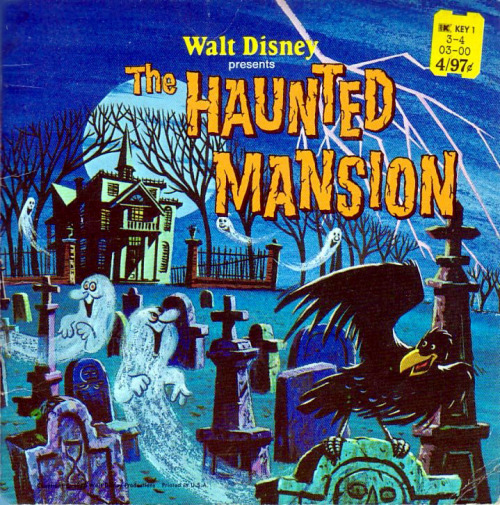
The Haunted Mansion 45, just fun!
The truly blood-curdling illustrations
of the Usborne Guides, this blogger
has more.


Five Little Pumpkins by Dan Yaccarino - it's the funnest song for
Halloween and pumpkins by far.


For full site, please visit edwardianjackal.com.